
Don’t miss the Summer Sock KAL with projects from Stories In Stitches 3!
Tips for arranging sts on different kinds of needles
Have you ever wondered what’s the best way to arrange your stitches on the needles as you knit a sock? When I started knitting socks, patterns were all written for dpns and told you exactly what to do. Now they’re “needle agnostic” because so many knitters make socks on circulars, and you’re left to your own devices to figure out how to split up the stitches. Here’s what I suggest:
Double Pointed Needles
- Cuff and Leg: Divide stitches into 3 or 4 equal sections (or almost equal if necessary to keep full repeats on each needle).

- Heel: Put the heel stitches on 1 needle and the remaining stitches divided equally on 2 needles to be worked later.
- Gusset Shaping: Divide the sole (including the gusset stitches picked up on each side of the heel) on 2 needles with the end of the round in the center of these 2 needles, and put the instep stitches on 1 or 2 needles; you will work gusset decreases on each of the sole needles on the ends furthest away from the center of the heel.
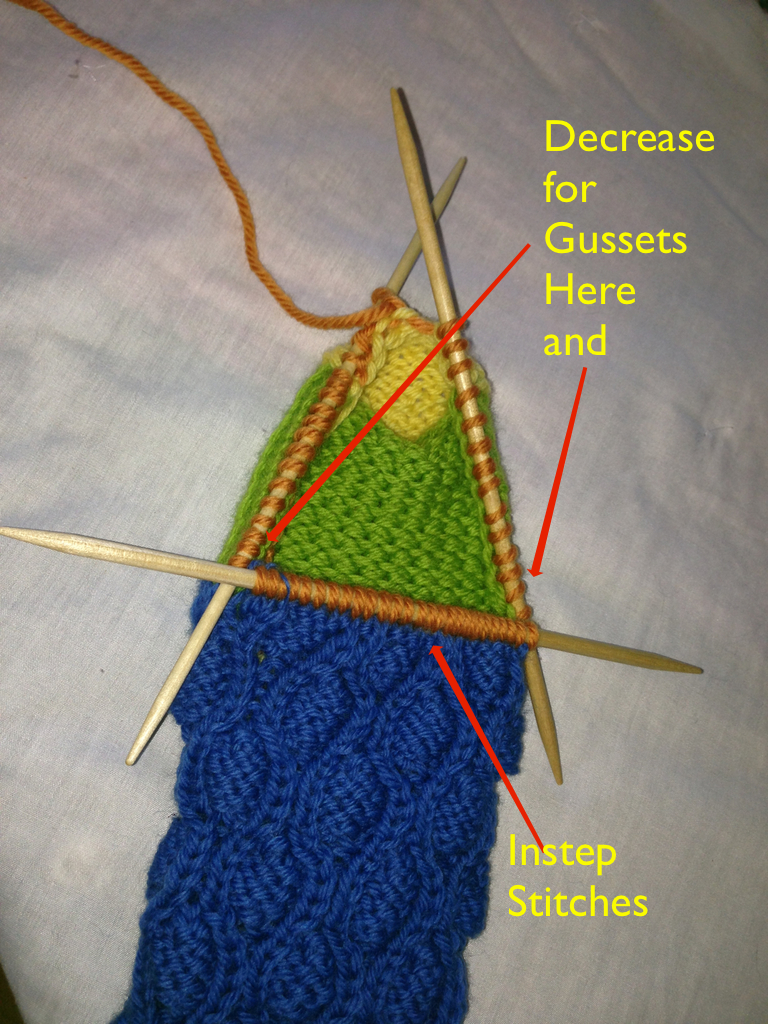
- Foot and Toe: Keep the instep on 1 or 2 needles and the sole divided equally on 2 needles
Two Circular Needles or Magic Loop
- Cuff and Leg: Divide the stitches in half with the back of the leg on one needle or section and the front of the leg on the second needle or section

- Heel: Put the heel stitches on 1 needle or section of needle and the remaining stitches on the other needle or section to be worked later
- Gusset Shaping: Beginning at the center of the heel, put half of the stitches (to the center of the instep) on one needle or section and the second half of the stitches (from the center of the instep to the center of the heel) on the second needle or section, placing markers between the sole and instep on each side; you will work gusset decreases in the middle of each section.
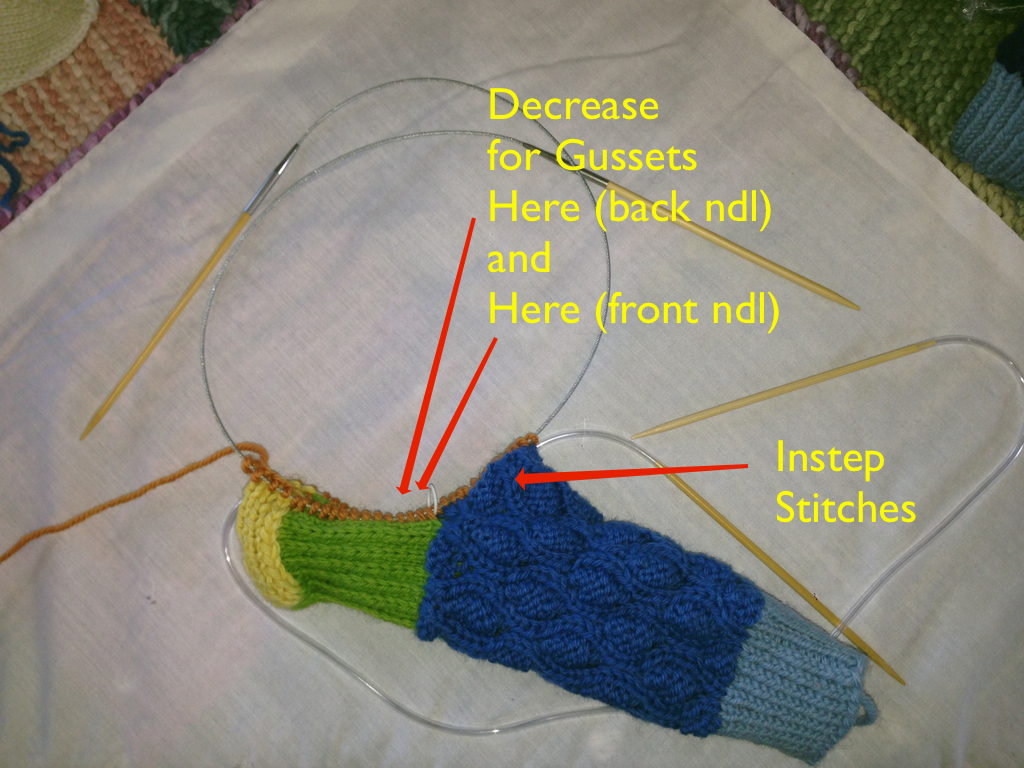
- Foot and Toe: Divide the stitches in half with the sole stitches on one needle or section and the instep stitches on the second needle or section
One Short Circular Needle
If you’re working on 1 short circular, there’s no trick. All of the stitches flow around the needle automatically. When working the heel, put the unworked stitches on scrap yarn or leave the unworked on the needle while working back and forth on the heel stitches.
Don’t miss the Summer Sock KAL with projects from Stories In Stitches 3!



 Experience level – advanced beginner
 After I finished my Arctic Lace Knitting Book, I finally allowed myself to explore the world of lace knitting and discovered that is is much more varied and elaborate than I could have imagined. Around the world and over time, knitters in different countries and regions have developed unique styles of lace knitting that range from easy-intermediate (like the knitting of the Oomingmak knitters) to advanced-insanely- difficult (like some of the Victorian patterns designed by English knitters). Other lace styles are used in Estonia, Russia, South America, Lithuania, Germany and Austria, and New Zealand. I’m sure there are even more, but these are the styles I’ve explored so far. – Donna Druchunas –


 Experience: All skill levels, basic knitting skills required.
 Have you ever wondered why some people can read charts easily and others find them incomprehensible? The truth is, charts are written in a code that can be deciphered by knitters who learn the symbols on the page and in their knitting. Charts do not use arbitrary symbols, but each symbol includes the instructions on how to make the indicated stitch! In this class, you will learn the secrets of interpreting chart symbols for texture and cable stitches.


